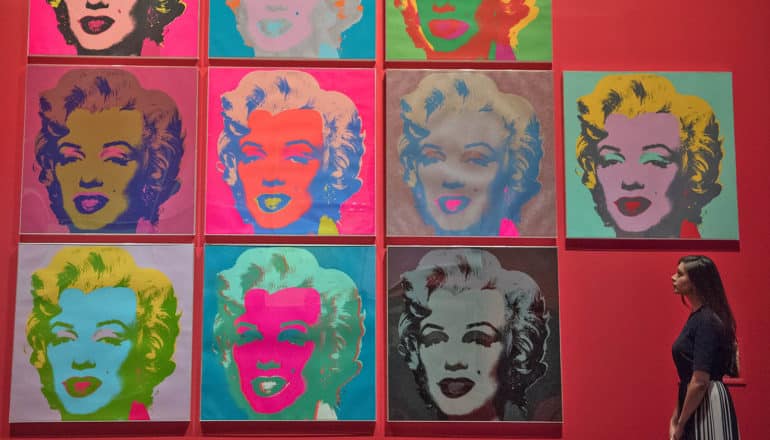
In advance of the United States Supreme Court hearing of Warhol Foundation v. Goldsmith, legal expert Amy Adler examines the role of fair use in contemporary art law.
Litigation in The Andy Warhol Foundation for the Visual Arts, Inc. v. Goldsmith began in 2017, when the art foundation preemptively sued celebrity photographer Lynn Goldsmith, who alleged copyright infringement by Warhol on a portrait she took of Prince. Goldsmith photographed the musician in 1981, and licensed the black and white portrait to Vanity Fair for an article titled “PURPLE FAME” in 1984. Warhol then cropped and colored the image, and its edited version appeared in the magazine. Before Warhol passed away in 1987, he created 15 more images from that same original Prince photo.
When Prince died in 2016, Vanity Fair printed one of them, which prompted Goldsmith’s claims of copyright infringement. Much of the litigation focused on whether or not Warhol had transformed Goldsmith’s photograph to give it new meaning, which is central to the Foundation’s argument that Warhol’s design is legal under the fair use doctrine.
So what constitutes fair use? Fair use doctrine permits third parties to use copyrighted work without an owner’s permission. The work may be used for news reporting, teaching, research, and other purposes.
Under the Copyright Act, four factors are considered in determining fair use:
- the purpose and character of the use;
- the nature of the copyrighted work;
- the amount and substantiality of the portion used, and;
- the effect of the use upon the potential market for or value of the copyrighted work.
In 2019, Judge John G. Koeltl of the Federal District Court in Manhattan ruled in favor of the Warhol Foundation, saying that Warhol had adequately transformed the photograph “from a vulnerable, uncomfortable person to an iconic, larger-than-life figure.” But shortly thereafter, a panel of the US Court of Appeals for the Second Circuit in New York reversed Judge Koeltl’s ruling.
The Supreme Court has agreed to hear this dispute in its new term, which begins in October 2022. In the past, the court has deemed a work transformative if it “adds something new, with a further purpose or different character, altering the first with new expression, meaning, or message.”
Here, Adler, professor of law at New York University, talks about fair use in contemporary art law and the implications of this dispute’s elevation to the Supreme Court:
The post Does Warhol’s image of Prince count as fair use? appeared first on Futurity.
from Futurity https://ift.tt/g0v2wzm

No comments:
Post a Comment