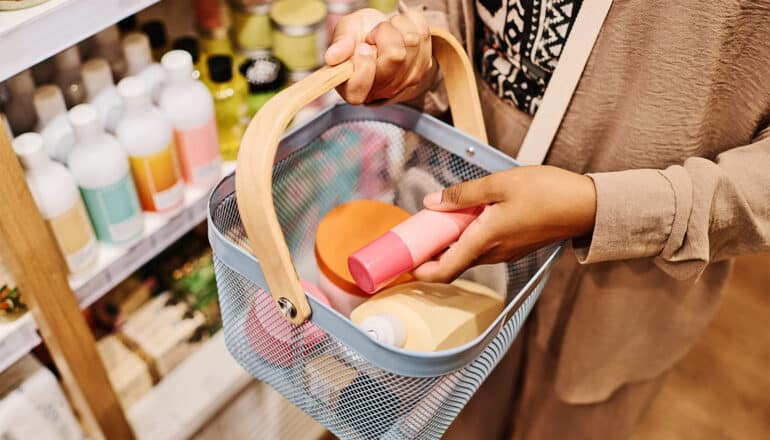
Analysis reveals that in the absence of federal regulation, “clean” beauty labels often leave consumers guessing, particularly women of color.
As consumers increasingly pivot toward safer, non-toxic personal care routines, the “clean beauty” market has exploded. However, the new research suggests that for consumers with textured hair, the “clean” label may not always equal “chemical-free.”
“…’clean’ is often nothing more than a marketing term.”
In a new study that will appear in the Journal of Exposure Science and Environmental Epidemiology, researchers analyzed the landscape of products marketed as “clean” for textured hair (curly, coily, and wavy) at a major retailer.
The findings highlight a significant regulatory gap: despite retailer efforts to curate safer options, the lack of a standardized federal definition for “clean” means consumers must still navigate a complex and often opaque marketplace.
The study, led by the University of California, Santa Barbara’s Environmental Studies Program and Columbia University Mailman School of Public Health, in partnership with Black Women for Wellness and Silent Spring Institute, utilized a specific Target store in South Los Angeles as a case study. Researchers web-scraped ingredient lists for 150 hair products labeled as “Target Clean” to assess their safety profiles using the Environmental Working Group’s (EWG) Skin Deep database.
While retailers like Target are leaders in the sustainability space—investing millions in green chemistry and creating internal standards to restrict certain chemicals—the study indicates that voluntary retailer efforts cannot fully substitute for federal regulation.
“As we looked at general products, there was a large range from safe to extremely hazardous. We were hoping that the ‘clean’ products would lean toward the safer side, but we were surprised to see that the majority were still moderate hazards,” says lead author Joaquín Madrid Larrañaga, a researcher at UC Santa Barbara.
“It shows that ‘clean’ is often nothing more than a marketing term.”
The analysis revealed that even within the “clean” aisle, significant data gaps and potential hazards remain. Seventy percent of the products analyzed listed “fragrance” or “parfum” as an ingredient. This umbrella term can legally hide a mixture of undisclosed chemicals, some of which are linked to endocrine disruption and allergic reactions, due to “trade secret” protections. Only 41% of the products analyzed were found in the EWG database. Of those that were listed, more than 90% were classified as a “moderate” risk to human health (hazard scores between 3 and 6) rather than “low” risk.
While many products carried “free-from” claims (e.g., “sulfate-free”), inconsistent labeling practices were observed. For instance, while 14.6% of products contained sulfates, only roughly half of the products carried the retailer’s “Formulated without Sulfates” badge, leaving over one-third of products inconsistently labeled.
The study focuses on textured hair products because they are disproportionately used by women of color, who already bear a heavier burden of exposure to endocrine-disrupting chemicals. The researchers describe this as the “environmental injustice of beauty”—where interlocking systems of oppression lead to unequal chemical exposures.
“It’s a no-win situation for women of color, particularly Black women. In their desire to avoid using chemical relaxers, they might seek out ‘clean’ branded natural hair products that still expose them to toxic chemicals,” says coauthor Lariah Edwards, a researcher at Columbia University Mailman School of Public Health.
Community partners emphasize that this confusion creates an unfair burden on the consumer.
“It is deeply upsetting that even ‘clean’ beauty labels can offer a false sense of safety and Black women are forced to work so hard just to protect their health from toxic chemicals in everyday hair products,” says Janette Robinson-Flint, executive director of Black Women for Wellness.
“This study shows that we need policy change that meaningfully regulates cosmetics and personal care products with enforceable standards.”
The researchers emphasize that the findings are not an indictment of a single retailer, but a call for industry-wide reform.
“The burden of proof to show a chemical is harmful usually comes when someone gets sick, and that is the reverse incentive that we should have,” says senior author Bhavna Shamasunder, professor of environmental studies and chair in Racially Just, Resilient, and Sustainable City Futures at UC Santa Barbara.
“This isn’t necessarily a retailer issue; it’s a manufacturing and regulatory problem.”
Until federal regulations are standardized, the researchers suggest consumers look out for and avoid the following ingredients often found in hair products: fragrances and parfum, sulfates, parabens, and phthalates.
Additional coauthors are from UC Santa Barbara, the Columbia University Mailman School of Public Health, the Silent Spring Institute, and Black Women for Wellness.
This work was supported by the Rose Foundation Consumer Products Funding Board, the California Breast Cancer Research Program, the National Institutes of Environmental Health Sciences, the Passport Foundation, and the Forsythia Foundation.
Source: UC Santa Barbara
The post ‘Clean’ beauty products often have hidden hazards appeared first on Futurity.
from Futurity https://ift.tt/yCIg2Ws

No comments:
Post a Comment